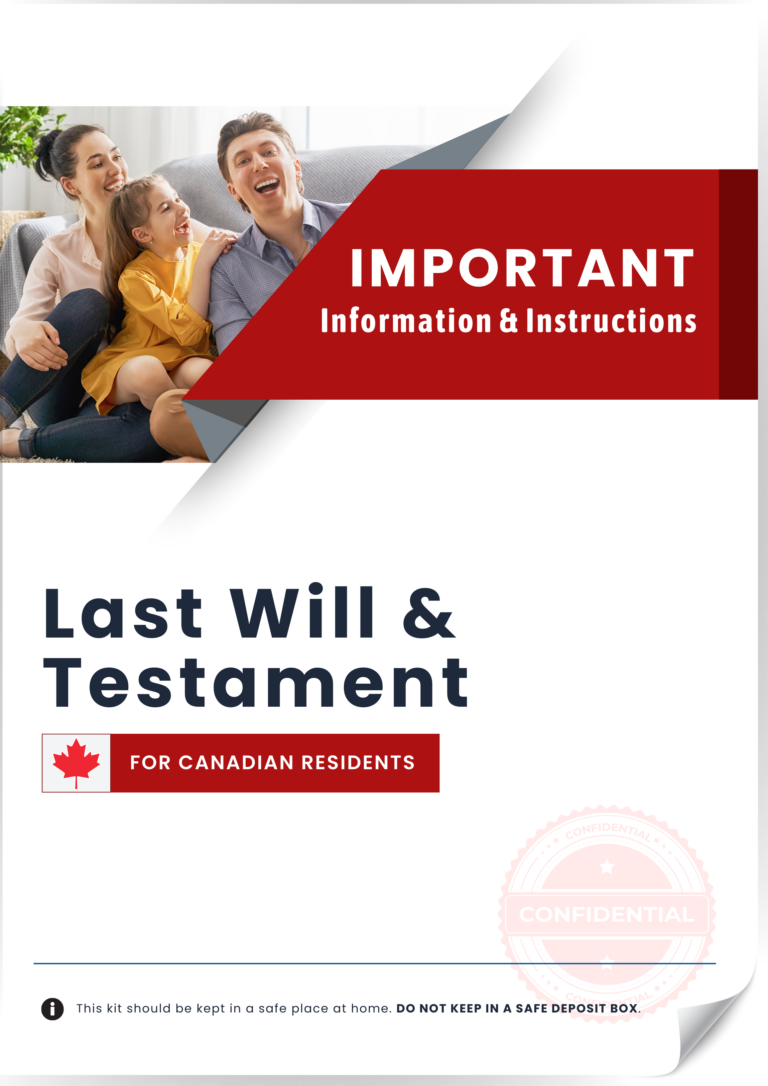
This guide provides Canadians with a clear, guided way to understand what a Last Will & Testament is, why it’s important, and how proper planning can protect loved ones and bring peace of mind for the future.
Understand what a Last Will & Testament is and how it works
Designate beneficiaries and guardians with clarity
Ensure their wishes are followed instead of default provincial laws
Reduce confusion and emotional stress for family members
Organize important personal and legal information in one place
1. Step-by-Step Will Kit
Clear, fill-in-the-blank pages to help you document your wishes without complicated legal jargon.
2. Benefits & Burial Planning Guide
A straightforward overview that helps your family understand available benefits and avoid confusion.
3. Document Organizer & Checklists
Easy worksheets to keep everything in one place so your family knows exactly where to find it.
4. One-on-One Support
A trained specialist will deliver your kit, walk you through it, and answer your questions. No obligation to use any additional services.
A licensed representative will virtually issue and explain your guide.
Receive your Will Kit & Burial Guide at no cost.
There will be additional products and services discussed, but there is no obligation to purchase anything to receive your guide.
A licensed local life insurance professional will contact you to schedule a virtual session. During the meeting, they’ll walk you through the contents of your kit, explain how to complete it, and provide information on any additional benefits you may be eligible for.
The best way to create your Last Will and Testament will depend on your personal circumstances. Since the LifeGuard Last Will and Testament Kit has been carefully drafted by lawyers and is ready to be customized with proprietary software, this is ideal for anybody looking to create a strong, legally binding Will from the comfort of their own home.
Since Wills need to be periodically updated, the LifeGuard Last Will and Testament Kit makes it easy to review your Will at any time because your work is saved when you create an account.
A Last Will & Testament allows you to give instructions on who will get your property after your death, appoint the person who will administer your estate, and appoint a guardian for any minor children you may have. If you die without a valid Will, your property will instead be distributed by a court-appointed administrator according to a pre-determined formula (defined in state/province law). Without a Will, you would not be able to give your property to a non-relative or to exclude relatives. If you have no Will and there are no relatives at the time of your death, your property will go to the state/province.
You can give away most, but not all, of your property in a Last Will. Typically the following cannot be given away in a Will:
– Life insurance
– 401(k) plan assets
– Pension plan assets
– Retirement plan assets
– Annuities
– Property held in a trust
– Matrimonial home held jointly
A Last Will is used to distribute your property after your death and cannot be used to specify what type of medical treatment you want. In contrast, a Living Will (aka a Health Care Directive) allows you to specify your preferences for health care when you are no longer capable of giving consent yourself.
Any person of legal age (usually 18 years of age) may make a Last Will, although an exception may be made if you are married, in the military, or have been legally emancipated. Additionally, most states require that you must be of “sound mind” to make a valid Will which means:
– You understand you are making a Will and you know what a Will is.
– You understand your relationship to the people mentioned in your Will; and
– You understand the types and amount of property you own and how you wish to distribute itA Last Will is used to distribute your property after your death and cannot be used to specify what type of medical treatment you want. In contrast, a Living Will (aka a Health Care Directive) allows you to specify your preferences for health care when you are no longer capable of giving consent yourself.
The author, the publisher and the vendor of these forms makes no representations or warranties regarding the outcome or the use to which these forms are put and are not assuming any liability for any claims, losses, or damages arising out of the use of these forms. The user should not rely on the author or the publisher of these forms for any professional advice. Always consult with a lawyer regarding the rules and regulations governing your residing state/province. The information provided is for illustrative purposes only and not for the purpose of providing legal advice. You should contact an attorney to obtain advice with respect to any particular issues and concerns related to the drafting of wills and other legal documents. Remember that individual situations and estate planning needs differ, and this Kit may not be suitable for your specific circumstances.